Practice
How to practise golf at home in winter
How to practise golf at home in winter: a simple weekly plan with a net, hitting mat and putting mat, drills for dark evenings, and kit that makes a good gift.
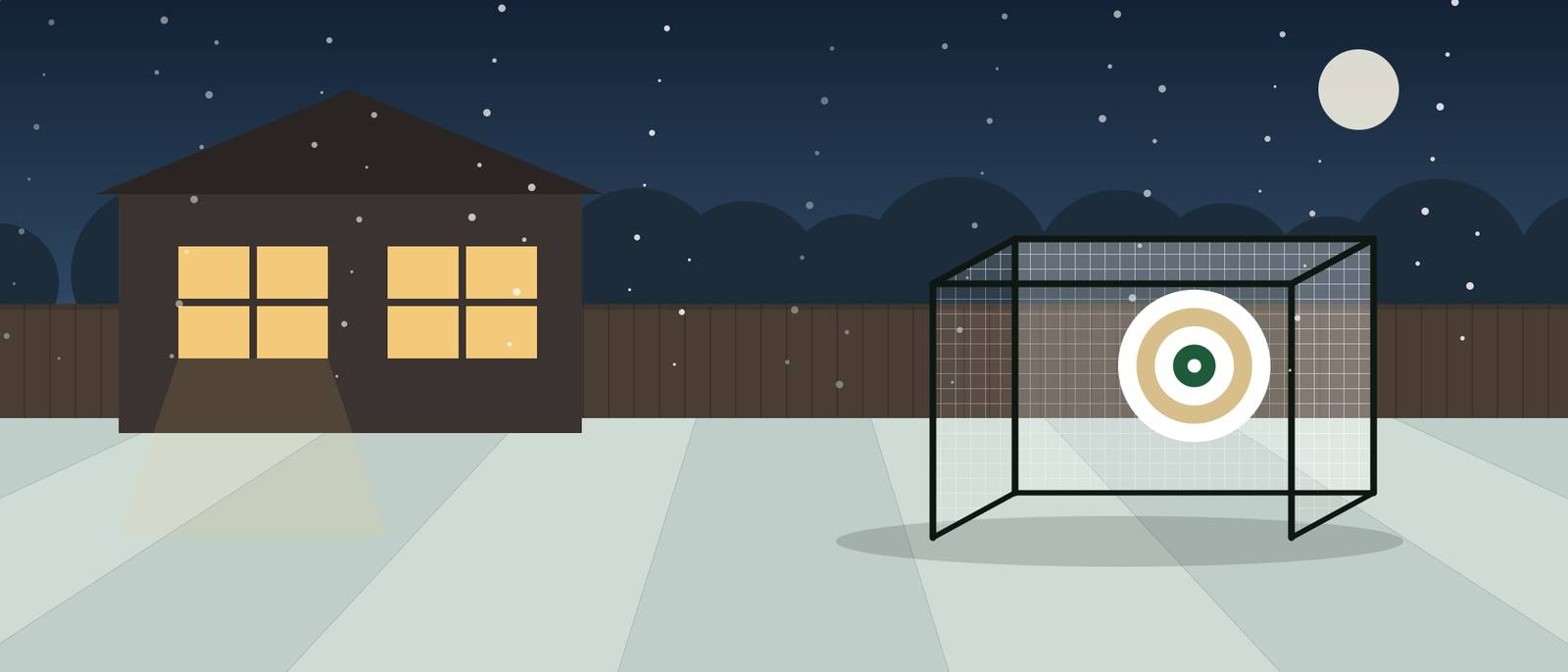
Winter in the UK is hard on golf. Courses get waterlogged, some holes play to temporary greens, and the days are short: in London the sun sets before 4 pm for most of December. For many golfers, that means two or three months with hardly any practice, and a slow start in spring.
It does not have to be that way. With a net, a mat and a putting mat, you can keep the parts of your game that matter most ticking over at home, and even improve them. This guide shows how to set up, what to practise and how to make it a habit.
Pick one or two things to work on
The biggest mistake with home practice is hitting balls without a purpose. Before winter starts, choose one or two things you want to be better at by spring. Good choices for home practice are:
- Strike: hitting the ball before the ground, from the centre of the face.
- Start line: sending the ball where you aimed it.
- Set-up and alignment: posture, ball position and aim.
- Short putts: holing everything inside about 1.5 m.
All four can be practised properly into a net and on a putting mat. Distance control with full shots and long putts on real greens are harder at home, so save those for the course.
The kit you need, and what can wait
Essentials
- A golf net big enough for the clubs you want to hit.
- A hitting mat with a cushioned base and a tee.
- An indoor putting mat for the hallway.
- Two alignment sticks, or two old clubs, to lay on the mat.
- Your phone, to film your swing from behind and from the front.
Nice to have
- A launch monitor, to see carry distance and start line.
- A simulator enclosure and projector, to play full courses on winter evenings.
If you have a garage, moving the net and mat inside for the winter solves the weather and the dark at the same time. Our garage golf simulator guide covers what to check.
A simple weekly plan
Short, regular sessions are easier to keep up than long, rare ones. Here is a plan that fits around work and family:
| Day | Session | Time |
|---|---|---|
| Monday | Putting mat: gate drill and short putts | 15 minutes |
| Tuesday | Net: wedges and short irons, strike drills | 30 minutes |
| Thursday | Net: mid irons and driver, start line with targets | 30 minutes |
| Saturday | Course or range if open, otherwise net with full routine | 30 to 60 minutes |
| Sunday | Putting mat: ten in a row from 1 m | 10 minutes |
Treat the times as a starting point. What matters is that each session has a clear aim and that you do them regularly.
Drills for the net
Start line with a target. Pick a ring on the net's target sheet. Lay one alignment stick along your toe line and one along the target line. Hit five balls, note how many start at the ring, then change club. Into a net, start line is the most honest feedback you have.
Low point drill. Place a thin towel on the mat, about a hand's width behind the ball. If you hit the towel, the club reached the ground before the ball. Move the towel closer as your strike improves. On a hard mat, this drill tells you what the mat itself might hide.
Half swings. Hit shots with a half backswing and a half follow-through, holding the finish. Control and strike improve at lower speed first.
One ball, one routine. For the last ten balls of each session, go through your full pre-shot routine for every shot, as you would on the course: stand behind the ball, pick a target, set up, swing. Change club every shot.
Film it. Once a week, film a few swings from behind and from the front. Compare them with last week, not with tour players.
Drills for the putting mat
Gate drill. Two tees just wider than the putter head, a short distance in front of the ball. Roll the ball through the gate cleanly.
Ten in a row. From 1 m, hole ten putts in a row. Miss one and start again.
Eyes closed. Set up, look at the hole, close your eyes and putt. It trains you to trust your stroke instead of steering it.
More drills, including some for a garden green, are in our putting green guide.
Making the most of dark evenings
With sunset before 4 pm, most weekday practice happens in the dark. A few practical points:
- Light. An outdoor floodlight pointed at the net, not at you or the neighbours, makes evening sessions possible in the garden. Better still, move into the garage.
- Footing. Wet grass and frost are slippery. Stand on the mat and wear shoes with grip.
- Warm-up. Cold muscles do not like fast swings. Spend a few minutes loosening up and start with half swings before you hit full shots.
- Neighbours. A ball landing in a net is not loud, but the strike itself can be heard next door on a still evening. Keep late sessions to wedges and irons if houses are close.
Track your progress
Practice is easier to keep up when you can see it working. Set yourself a few simple tests at the start of the winter and repeat them once a month:
| Test | How to do it | What to record |
|---|---|---|
| Short putts | 10 putts from 1 m on the putting mat | how many you hole |
| Start line | 10 balls with a 7-iron at one ring of the target | how many start at the ring |
| Strike | 10 balls with the towel drill | how many miss the towel |
| Routine | last 10 balls with a full routine, changing club | how many feel committed |
Write the results in a notebook or on your phone, with the date. The numbers do not need to be impressive. They need to move in the right direction, and they tell you what to spend next month's sessions on. If you have a launch monitor, add your average carry with two or three clubs.
Look after your kit over the winter
Wind, rain and cold wear out practice kit faster than use does:
- Nets: take a garden net down before storms and dry it before you store it. Check the impact area for holes each time you put it up.
- Mats: let a wet mat dry out on its edge, and do not leave it lying on frozen ground.
- Electronics: charge battery-powered launch monitors indoors, and bring them inside after a session in a cold garage to avoid condensation.
When you do get out on the course
Cold, dense air slows the ball more than warm air does, so expect your shots to fly shorter in winter than in summer. That is normal, not a sign that your practice is not working. Use the course days to test what you have worked on at home, and keep notes on what to practise next.
Gift ideas for golfers who practise at home
Winter is also when many golfers get their practice kit, often as a Christmas present. A few ideas, from small to large:
- Indoor putting mat: fits in almost any home and gets used every day.
- Hitting mat: a big upgrade for anyone who already has a net and a thin mat.
- Garden golf net: the start of home practice for anyone with a garden.
- Launch monitor: for the golfer who wants numbers.
- Simulator enclosure: a big project, best planned together.
For the larger items, check the space first. Our guide on home golf simulator space explains how much room a full set-up needs, and the golf net buying guide covers gardens.
Frequently asked questions
Can you get better at golf by practising at home?
Yes. Strike, start line, set-up, routine and putting can all be worked on at home. What you cannot see into a net is the full ball flight, which is where a launch monitor or the odd range session helps. Combine the two and you lose very little over the winter.
Is it OK to hit golf balls into a net in the garden?
Yes, with a proper golf net, a safe set-up and some thought for the neighbours. Make sure a missed ball cannot reach a window or the next garden, keep people away from the hitting area, and avoid early mornings and late evenings if the net is close to other houses.
How often should I practise in winter?
Whatever you can keep up. Two or three short sessions a week with a clear aim are easier to stick to than one long session when you feel like it. Put them in the diary like a tee time.
What is a good golf gift for someone who practises at home?
A putting mat suits almost every golfer and every home. A good hitting mat is a big upgrade for anyone who already has a net. A net, a launch monitor or a simulator enclosure are bigger gifts, so check the space and the size first.