Space guide
Home golf simulator space: ceiling height, width and depth
How much space a home golf simulator needs: ceiling height, room width and depth for radar and camera launch monitors, and how to test your own room.
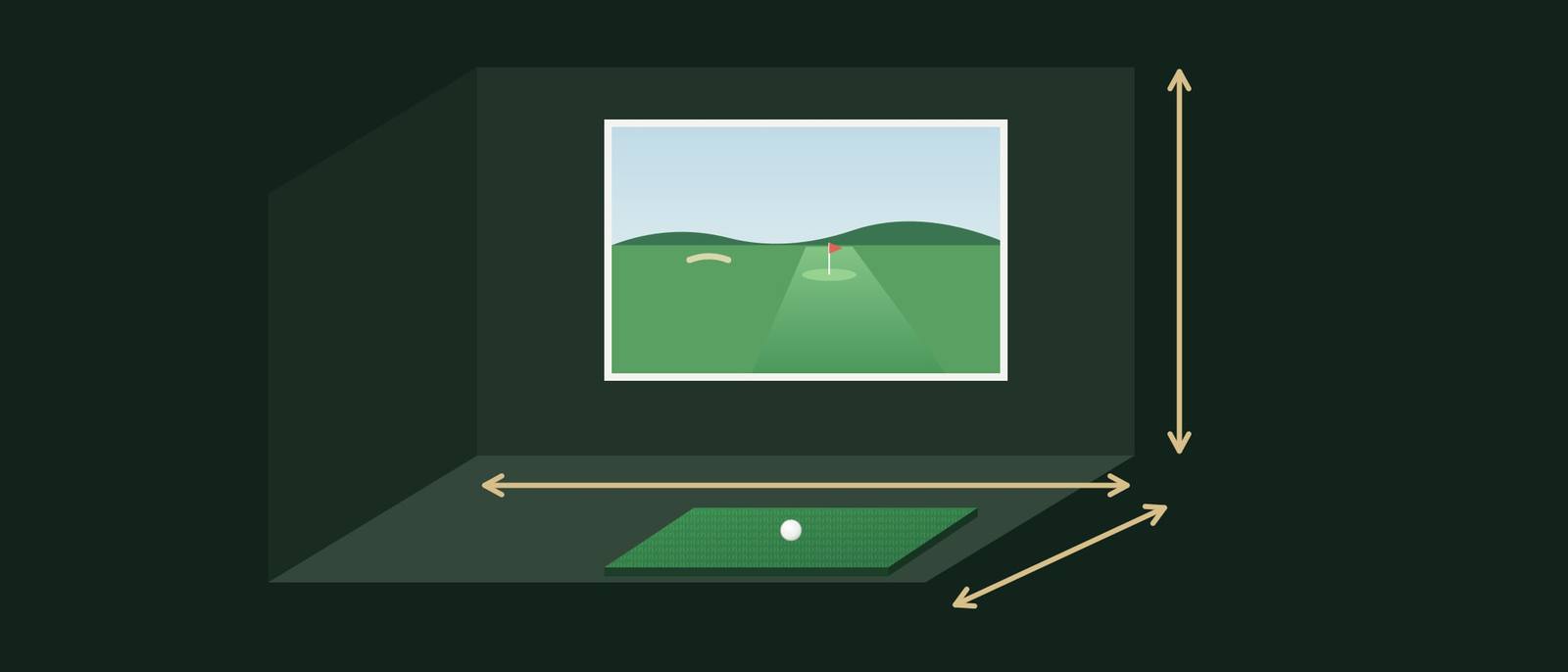
Short answer: retailers and launch monitor makers commonly quote a ceiling of 2.8 to 3 m, a width of at least 3 m and a depth of 4 to 5.5 m, depending on the type of launch monitor. Of the three, ceiling height is the one you cannot change, so measure it first and test it with your own swing. Depth depends mostly on whether your launch monitor uses radar or cameras.
This guide explains where those numbers come from, so you can work out what your own room needs instead of relying on a single figure.
The three numbers at a glance
| Measurement | Commonly quoted minimum | More comfortable | What decides it |
|---|---|---|---|
| Ceiling height | about 2.8 m (9 ft 2 in) | 3 m (about 10 ft) or more | your height, the club, how upright you swing |
| Width | about 3 m (9 ft 10 in) | about 4.5 m (15 ft) or more | one or two-handed use, how safe the bay feels |
| Depth | about 4 m for camera units, about 5 m for radar units | 5.5 m (18 ft) or more for some radar systems | launch monitor type, ball-to-screen distance |
These figures are a summary of what UK retailers and launch monitor makers publish for their own systems. They are a starting point. Your launch monitor's manual has the final say on depth, and your swing has the final say on height.
Ceiling height: the number you cannot change
The driver is the longest club in the bag, and at the top of the backswing and at the finish the club head travels well above your head. How high it goes depends on your height, the length of the club and how upright your swing is. Two people of the same height can need different ceilings.
That is why a single "minimum" figure only gets you so far. The reliable way to find out is to test it:
- Stand where the hitting mat will go, on a surface of the same height as the mat.
- Take your driver and make slow swings, stopping at the top of the backswing and at the finish. Ask someone to watch the club head.
- Measure from the floor to the highest point the club head reached, using a tape measure while you hold the position.
- Add a safety margin. A full-speed swing is longer than a slow one, and shafts flex.
Look for the lowest point in the swing area, not the average ceiling height. Beams, light fittings, garage door rails and a ceiling-mounted projector all count. A projector should hang where the club can never reach it, usually in front of the hitting area.
If your ceiling falls short, you can still practise with shorter clubs. Many golfers in lower rooms hit wedges and irons only and leave the driver for the range. Do not try to "make do" by swinging a driver under a ceiling you have already hit in testing.
Width: room to swing and to feel safe
You stand to one side of the ball, about a club's length away, and your swing needs room behind you as well as in front. Width also gives a margin for the shots nobody plans: a shank or a heel strike goes sideways, and the side panels of an enclosure have to catch it.
A width of around 3 m works for one right-handed player with the hitting spot set off centre. A right-handed golfer stands on the left of the ball when you look from behind it towards the screen, so moving the ball towards the right-hand side of the bay gives them more room behind their back. A left-handed player is the mirror image.
If both left and right-handed players will use the bay, the ball has to sit in the middle, with room for a full swing on both sides. That is where the more comfortable widths of 4 m and above come from. A long mat with a stance area on each side, like our simulator hitting and stance mat, avoids moving the mat between players.
Depth: the launch monitor decides
Depth is made up of four pieces. Add them together for your own room:
- Gap behind the screen. An impact screen needs room to move. Common advice is around 30 cm (12 in) between a framed screen and the wall, and more for a screen that hangs loosely.
- Ball to screen. The ball needs some flight before it hits the screen, and the launch monitor needs to see enough of it. As an example, one popular portable radar unit asks for at least 2.4 m (8 ft) between ball and net. Simulator makers often suggest around 3 m.
- You and your swing. You stand beside the ball, and your backswing needs clear space behind the hitting area.
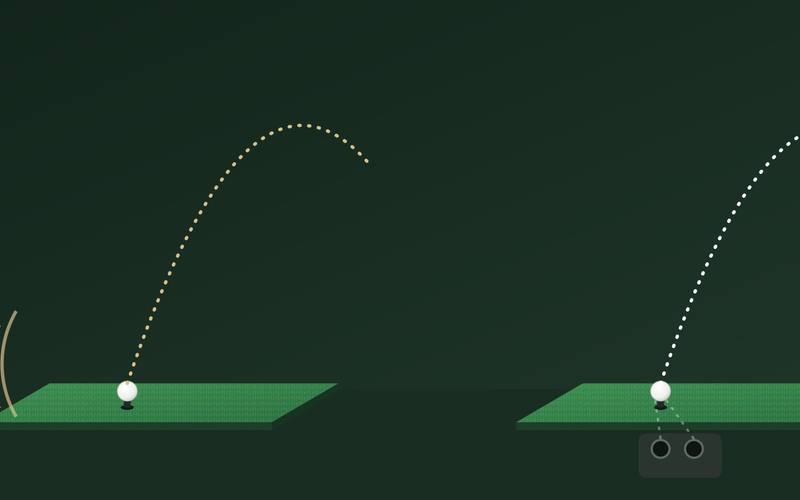
- The launch monitor. A radar unit sits behind the ball. The same portable radar unit asks to be placed 1.8 to 2.4 m (6 to 8 ft) behind the ball. A camera unit sits beside the ball and adds no depth.
Here is how that adds up for two typical set-ups:
| Piece | Camera unit beside the ball | Radar unit behind the ball |
|---|---|---|
| Gap behind the screen | 0.3 m | 0.3 m |
| Ball to screen | 2.5 m | 2.5 m |
| Space behind the ball | about 1.5 m for your swing | 1.8 to 2.4 m for the unit |
| Total depth | about 4.3 m | about 4.6 to 5.2 m |
The numbers in this table are an example, not a rule. Check the minimum distances in the manual of the launch monitor you plan to use, then draw the layout on paper with the real figures. If you have not chosen a launch monitor yet, golf launch monitors explained compares radar and camera units.
Garden rooms and sheds: watch the height limits
A garden room can make a great simulator bay, but height is the catch. In England, outbuildings built under permitted development (without a planning application) have height limits: no more than 2.5 m at the eaves, no more than 4 m overall with a dual-pitched roof or 3 m with any other roof, and no more than 2.5 m overall if the building is within 2 m of a boundary. These limits are set out on the Planning Portal.
The inside ceiling is always lower than the outside height, because the floor and roof build-up take some of it. So a flat-roofed garden room tucked against the fence, at 2.5 m outside, will not give you 2.8 to 3 m inside. The usual options are a building more than 2 m from the boundary with a pitched roof, or a planning application. Different rules apply in Wales, Scotland and Northern Ireland, on designated land and for listed buildings, so check with your local planning authority before you order a building.
Step by step: measure your room
- Ceiling at the hitting spot. Measure to the lowest point above the swing area, including lights, beams and door rails.
- Width at the hitting spot. Measure wall to wall where you will stand, not at the doorway.
- Depth. Measure from the wall where the screen will go to the opposite wall.
- Swing test. Do the slow driver test described above and note the highest point.
- Draw the layout. Mark the screen gap, the screen, the ball position, the mat, the launch monitor and where you will stand.
- Check the practical things. Sockets near the launch monitor and projector, a way to darken the room, a level floor and a door you can carry the frame through.
What if your room is smaller?
A room that falls short of the numbers above can still be a good place to practise. A golf net and a hitting mat need less depth than a full simulator, and you can hit wedges and irons under a lower ceiling. A camera-based launch monitor saves depth compared with radar. And an indoor putting mat needs nothing more than a hallway.
If the space is tight, start with the parts that do not depend on the final layout, such as the mat and a net, and plan the rest once you know exactly what fits. For a full build in a garage, read the garage golf simulator guide.
Frequently asked questions
What is the minimum ceiling height for a golf simulator?
Retailers and launch monitor makers commonly quote about 2.8 m (just over 9 ft) as a minimum and 3 m (around 10 ft) as a comfortable height. Taller golfers and upright swings need more. Test it in the room with your driver before you buy anything.
Can I fit a golf simulator in a single garage?
Sometimes. Many single garages are well under 3 m wide inside, which is tight for a full swing, and the door mechanism often lowers the usable height. Measure the width at the hitting position and the height under the door rails. A double garage is usually the easier fit.
How far should the ball be from the screen?
Follow your launch monitor's manual. As an example, one popular portable radar unit asks for at least 2.4 m (8 ft) between the ball and the net or screen, and simulator makers often suggest around 3 m. Too close and the ball comes back faster and harder.
Do left and right-handed players need more space?
They need more width. If both will use the bay, the ball has to sit in the middle with room on both sides, so allow extra width compared with a bay for one right-handed player, where the hitting spot can be moved off centre.