Buying guide
Putting greens for home and garden: mats, turf and build
Putting greens for home and garden: indoor putting mats or garden greens, what makes a true roll, how to prepare the base and lay a green, and drills that work.
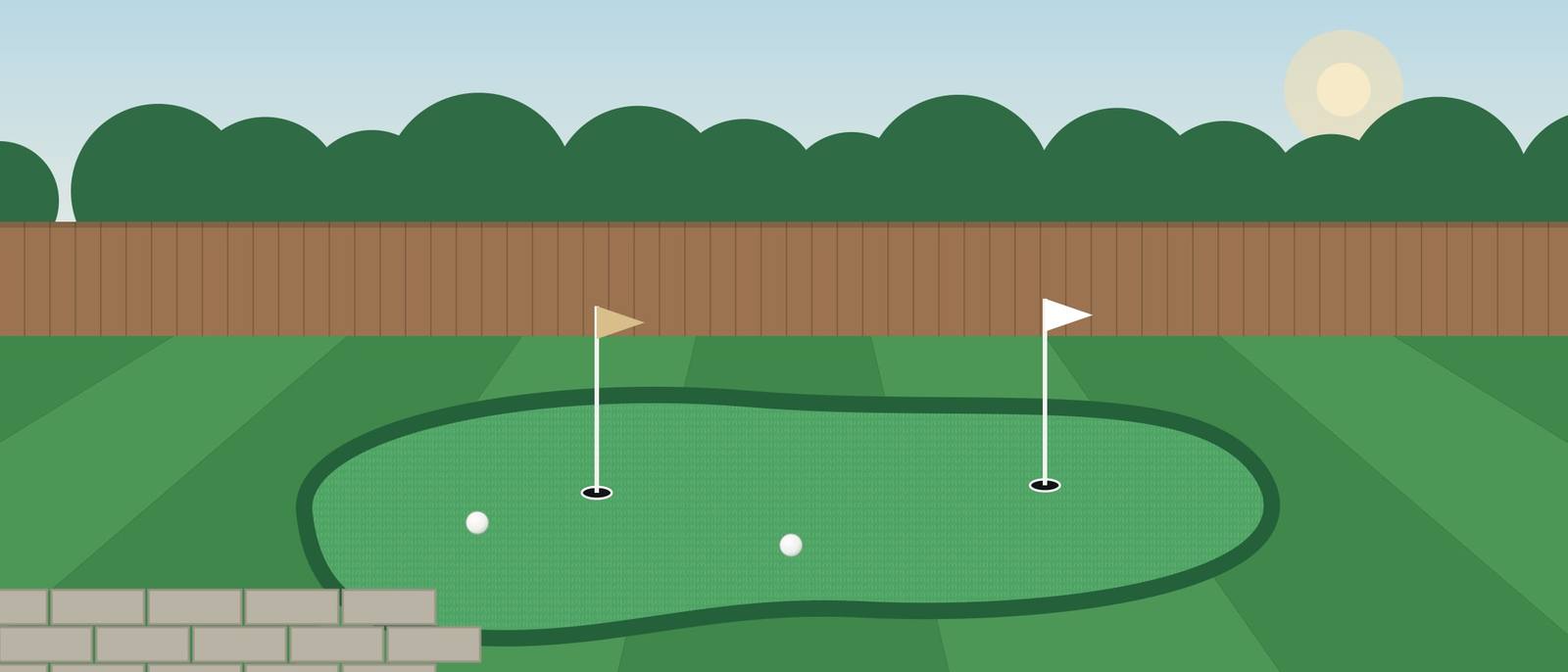
Putting is the one part of golf you can practise properly at home with very little space. A few minutes a day rolling putts on a mat in the hallway builds a repeatable stroke, and a green in the garden lets you work on pace and break whenever you have a spare twenty minutes.
This guide compares indoor putting mats and garden putting greens, explains what makes a putting surface roll true, and walks through how a garden green is built.
Indoor putting mat or garden green?
| Indoor putting mat | Garden putting green | |
|---|---|---|
| Space | a hallway, office or living room | a flat area of the garden |
| Typical length | about 3 m | as big as you have room for |
| Set-up | unroll and play | groundwork, base and turf |
| Slopes and break | flat | can be shaped into the base |
| Best for | short putts, stroke, start line | pace, break, chipping onto a green |
| Season | all year | all year, weather permitting |
Many golfers end up with both: a mat indoors for daily short putts and a green outside for longer putts and chipping.
What makes a good putting surface?
A true roll. The ball should roll straight on a flat surface, with no seams, ridges or curling edges that knock it off line. On a mat, that means a flat backing and a floor without bumps underneath. On a green, it means a carefully prepared base.
A consistent speed. On golf courses, green speed is measured with a Stimpmeter: a grooved bar that releases a ball at a fixed point, after which you measure how far the ball rolls, in feet. The higher the number, the faster the green. Synthetic turf makers often describe their surfaces in the same way. A home surface does not have to match any particular course, but it should roll the same way every day.
A real cup. Under the Rules of Golf, the hole is 108 mm (4¼ in) in diameter. Practice cups that are smaller make you more precise, but if you want your practice to match the course, choose a full-size cup.
Choosing an indoor putting mat
- Length. Around 3 m covers short and medium putts, the ones you most want to hole. A longer mat helps with pace.
- Floor. A hard floor or short carpet gives the smoothest roll. Deep-pile carpet under a mat creates dips.
- Backing. A non-slip backing keeps the mat still. Unroll a new mat a day before using it so the edges settle flat.
- Return. A ramp that sends the ball back saves walking after every putt; a cup in the surface is closer to the real thing.
- Aim lines. Printed lines or dots help you check that the ball starts where you aimed.
Our indoor putting mat is about 3 m long with aim lines and a ball return.
Planning a garden putting green
Before you dig, think about these points:
- Position. A flat or gently sloping area, away from trees that drop leaves and send roots under the base.
- Drainage. Water has to get away. A green on a low spot where puddles form will need extra drainage.
- Shape and size. Even a green of 3 × 1.5 m gives plenty of putts. Curved shapes look more natural and give putts of different lengths.
- Cup positions. Two or three cups on different lines make every putt different.
- Chipping. If you want to chip onto the green, leave room around it to stand, ideally on a hitting mat.
How a garden green is built, step by step
The method below follows the way UK installers typically lay artificial grass, with the extra care a putting surface needs. Depths vary between installers and turf makers, so follow the instructions for the turf you buy.
- Mark out the shape with a hose or spray paint.
- Dig out the grass and topsoil. UK installers commonly excavate about 75 to 100 mm below the finished level for artificial grass.
- Fit an edging of timber, steel or plastic around the shape to hold the base in place.
- Lay the sub-base. A layer of crushed stone sub-base (often called Type 1 or MOT), commonly around 50 to 75 mm deep for a garden, compacted with a plate compactor.
- Add the laying course. A finer layer, often granite dust or sharp sand of about 20 to 25 mm, screeded and compacted. This is where you shape any gentle slopes.
- Check it. Roll a ball across the base, and drag a long straight edge over it. Fix every dip now. The turf will show every flaw in the base.
- Lay a weed membrane where the installation method calls for it.
- Set the cups into the base at the positions you planned.
- Lay the turf, cut it to shape, cut out the cups and fix the edges. Join any seams carefully, away from the main putting lines if possible.
- Add infill if the turf is made for it, brushing it in evenly.
- Test the roll and adjust.
Our garden putting green is sized at about 3 × 1.5 m with two cups, made for a base prepared this way.
Adding a chipping area
A green in the garden invites chipping, and that is where many golfers save the most practice time. A few points make it work:
- Hit from a mat, not the lawn. Put a hitting mat a few metres from the edge of the green. Chipping off the lawn wears the grass into bare patches quickly.
- Use a fringe. A band of longer synthetic turf around the green softens the first bounce and stops chips running straight across a small green.
- Land the ball on the green. Pick a landing spot rather than the hole, and watch how far the ball runs out. That ratio of carry to roll is what you take to the course.
- Use soft practice balls if the green is close to the house. A thinned chip with a real ball travels a long way, and a window is a small target to miss.
Speed and slope on a home green
Synthetic putting surfaces can be quick, and on a quick surface a small slope makes a big break. Keep any slopes you shape into the base gentle, and test them with a ball before the turf goes down. If the turf uses sand infill, the amount of infill and how often you brush it affect the speed, so follow the maker's guidance and change one thing at a time.
Looking after a putting green
- Brush the surface regularly to keep the fibres upright and the infill even.
- Clear leaves and debris before they rot on the surface.
- Treat moss and weeds at the edges early.
- Top up infill where it thins, if your turf uses it.
- Keep heavy furniture and barbecues off the putting surface.
Putting drills that work at home
Gate drill. Push two tees into the mat or green just wider than the putter head, about 15 cm in front of the ball. Roll putts through the gate without touching the tees. It shows whether the ball starts on line.
Ladder drill. Put down markers at 1, 2 and 3 m. Putt one ball to each, then back down the ladder. It trains pace, the skill that a mat alone cannot fully teach.
Make ten in a row. From 1 m, hole ten putts in a row. Miss one and start again. Move back when it becomes easy. It adds a little pressure to practice.
Clock drill. On a garden green, put balls in a circle around a cup at the same distance and hole them all. Each putt has a slightly different break.
For more ideas on keeping practice going through the colder months, read how to practise golf at home in winter, or see our putting greens and mats.
Frequently asked questions
What size is a golf hole?
Under the Rules of Golf, the hole is 108 mm (4¼ in) in diameter and at least 101.6 mm (4 in) deep. Some practice mats use a smaller cup to make putting harder, so check the cup size if you want to practise to a real hole.
Can a garden putting green have slopes?
Yes. The slopes are shaped in the base before the turf goes down, usually in the fine laying course. Keep them gentle: a small amount of slope gives plenty of break on a fast synthetic surface.
Does a synthetic putting green need sand infill?
It depends on the turf. Some putting turfs are made to be filled with sand, which holds the fibres up and sets the speed. Others are made to be used without infill. Follow the maker's instructions for the turf you buy.
Can I lay a garden putting green myself?
Yes, if you are comfortable with groundwork. The hard part is the base: digging out, compacting the sub-base and getting the laying course smooth. Hiring a plate compactor makes a big difference. For large or sloping sites, a landscaper who lays artificial grass can do the base.