Buying guide
Choosing a golf hitting mat: turf, base, size and tees
How to choose a golf hitting mat for the garden, garage or simulator: turf, cushioned base, size, rubber tees and how to stop the mat sliding about.
The hitting mat is the piece of home practice kit you touch on every single shot. It decides how a strike feels, how honest that feeling is, and how your wrists and elbows feel after a hundred balls. It is also the piece many people buy last and spend least on, usually as an afterthought to a net.
This guide explains what separates a good mat from a poor one, so you can choose one that suits your space and the way you practise.
What a hitting mat has to do
A good mat does five jobs:
- Let the club move through like a tight fairway lie, without grabbing or skidding.
- Cushion the contact when the club meets the ground, especially on a hard floor.
- Hold the ball up on a tee for drivers and woods.
- Stay flat and in place, shot after shot.
- Last, because the same small patch takes almost every strike.
Most cheap mats manage the first and third. The difference between mats is mostly in the second, fourth and fifth.
The turf on top
The surface is synthetic turf, usually made of nylon or polypropylene fibres. What you feel is decided by the density and the pile height: dense, short fibres behave like a tight lie, longer fibres let you push a real tee into the mat and feel more like light rough.
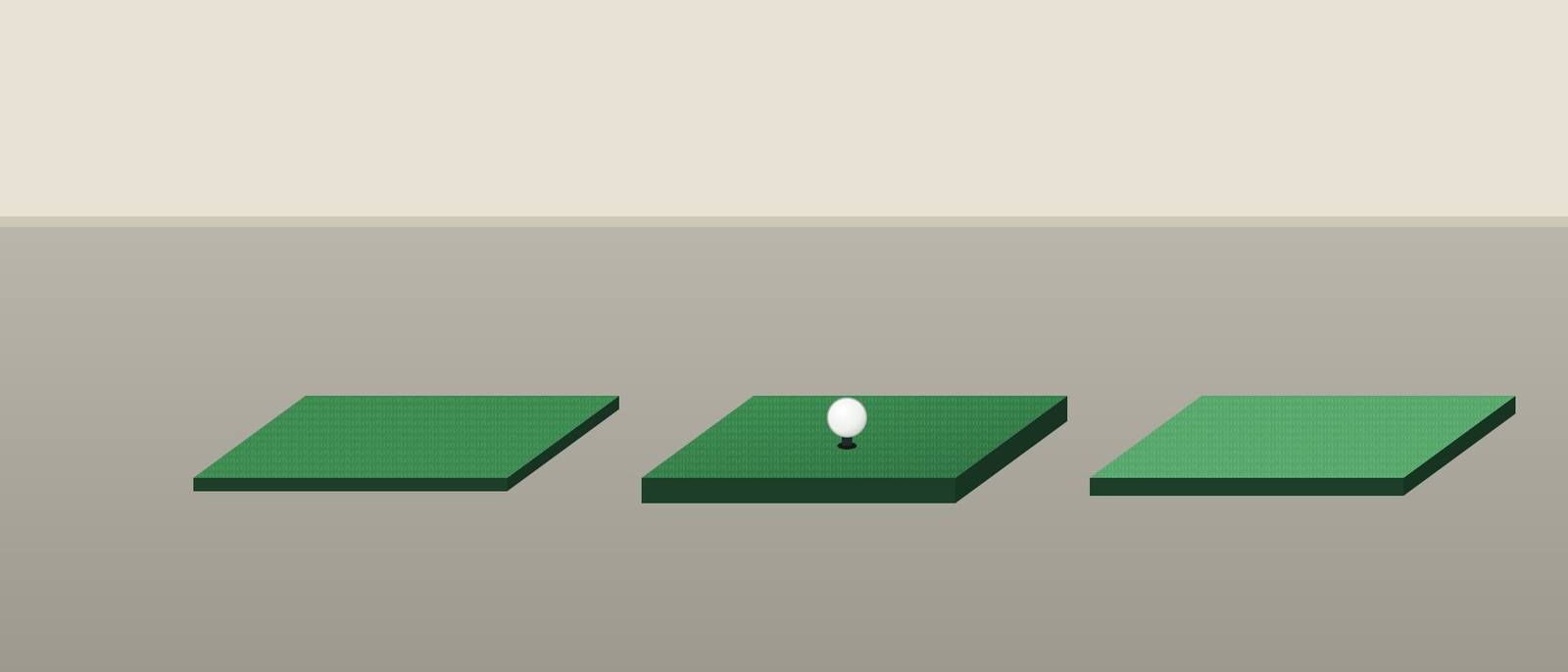
Some mats have two or three surfaces side by side, often sold as dual or tri-turf mats, with different pile heights for fairway, rough and tee shots. They are useful if you want to practise from different lies, and less useful if you mostly hit full shots from one spot.
Turf on a good mat stands back up after each shot. On a worn or low-quality mat, the fibres flatten into a shiny patch, and the club starts to skid on it.
The base: where the comfort comes from
Under the turf sits the base, usually a layer of foam, rubber or both. This is the part that matters most if you practise on concrete, which is what most garages and patios are.
On real grass, the club enters the ground and the turf gives. On a thin mat laid on concrete, nothing gives. You feel the impact through your hands and arms, and if you hit the ground before the ball, the club bounces off the hard surface into the ball and the shot can look fine. That is why golfers who practise only on hard mats sometimes find their strike is worse on the course than they expected.
A cushioned base does two things. It takes the sting out of contact, and it lets a heavy shot feel heavy. Look at how the base is built, not only the total thickness of the mat. A thick, soft pile on a thin backing is not the same as a firm turf on a proper shock-absorbing layer.
Size: stand on the same surface as the ball
If you stand on the floor and the ball sits on a mat, the ball is higher than your feet by the thickness of the mat. With a thick mat, that changes your set-up slightly on every shot. There are two ways to solve it:
- A mat big enough to stand on. A mat of about 1.5 × 1.5 m (roughly 5 × 5 ft) lets you stand and hit from the same surface. It suits a garden net or a garage.
- A separate stance mat of the same height next to a smaller hitting mat.
For a simulator bay used by both left and right-handed players, a long mat of about 1.5 × 3 m with the hitting area in the middle and a stance area on each side is the tidy answer. Nobody has to move the mat, and the ball position stays the same for the launch monitor. Our simulator hitting and stance mat follows this layout.
Tees
Most practice mats use rubber tees, which push into a hole in the mat. They come in different heights. For a driver, you want the ball to sit high enough that about half of it is above the top of the club face at address, so check that a tall tee is available for your mat.
Some mats have a deep pile or a special insert that accepts a real wooden or plastic tee, which lets you set any height you like. It is a nice feature but not essential.
The tee hole wears over time. A mat with a replaceable hitting insert lasts longer, because you change the insert rather than the whole mat.
Outdoor mats
A mat that lives in the garden needs to cope with rain. Look for a mat that drains or dries quickly and is made for outdoor use. More important than the mat itself is what it sits on:
- Paving slabs or a patio give a firm, flat base.
- A bed of compacted sub-base works well for a permanent spot on a lawn.
- Soft grass is the worst option. The mat rocks, the ball position changes, and the grass underneath dies into a hollow.
Over winter, store the mat dry if the maker does not say it can stay out all year. Water trapped in foam layers and repeated freezing are hard on any mat.
Keeping the mat in place
A mat that slides a few centimetres on every shot is irritating and can be unsafe. On a smooth garage floor, a rubber underlay or a non-slip backing stops most movement. In a simulator bay, a mat that fills the space between the enclosure sides has nowhere to go. Outdoors, a heavy mat on a firm base usually stays put, and a frame or edging around it helps.
Looking after a hitting mat
- Brush the turf now and then to lift flattened fibres.
- Hit from slightly different spots if your mat allows it, to spread the wear.
- Clear away grit and leaves outdoors, as they act like sandpaper under the club.
- Replace the hitting insert or the rubber tee when they wear, before they damage the rest of the mat.
Which mat for which set-up?
| Set-up | What to look for | Size |
|---|---|---|
| Garden net on a lawn | outdoor mat, firm base underneath, tall rubber tee | about 1.5 × 1.5 m |
| Garden net on a patio | cushioned base, non-slip backing | about 1.5 × 1.5 m |
| Garage net | cushioned base for concrete, rubber underlay | about 1.5 × 1.5 m |
| Simulator bay, one player | cushioned base, level stance | 1.5 m square or larger |
| Simulator bay, left and right-handed | hitting area in the middle, stance on both sides | about 1.5 × 3 m |
| Chipping next to a putting green | short, dense turf for tight lies | a small mat is enough |
If you are buying your first net and mat together, a set takes the guesswork out of matching them. If you already have a net and a thin starter mat, upgrading the mat is often the biggest improvement you can make to how practice feels.
Quick checklist
- Will you use it indoors, outdoors or both?
- Does it have a real cushioned base, and what floor will it sit on?
- Can you stand on it, or do you need a stance mat?
- Does it take a tall enough tee for your driver?
- Can the hitting area be replaced?
- How will you stop it sliding?
A mat works hand in hand with a net or a simulator enclosure. The golf net buying guide covers the net side, and you can compare our hitting mats side by side.
Frequently asked questions
Is it bad to practise off a hitting mat?
Not if the mat is good and you know its limits. A thin, hard mat can hide heavy contact because the club bounces into the ball instead of digging. A mat with a cushioned base gives more honest feedback. Mix in sessions on grass when you can.
How thick should a golf hitting mat be?
There is no single right figure. What matters is that the mat has a real cushioned base under the turf, not just turf glued to a thin backing, especially on a concrete garage floor. Compare the build of the base, not only the total thickness.
Can I leave a hitting mat outside?
Many mats are made for outdoor use, but water and frost are hard on foam layers. A mat on a firm, free-draining base dries faster. Stand it up or bring it in over the winter if the maker does not say it can stay out all year.
What size hitting mat do I need for a golf simulator?
For one player, a mat of about 1.5 m square with a level stance works. If left and right-handed players share the bay, a long mat of about 1.5 × 3 m with the hitting area in the middle and a stance on each side saves moving the mat between turns.