Buying guide
Golf net for the garden: how to choose a practice net
How to choose a golf practice net for a UK garden: net types, opening size, frame and netting, rebound and where to put it so windows and neighbours stay safe.
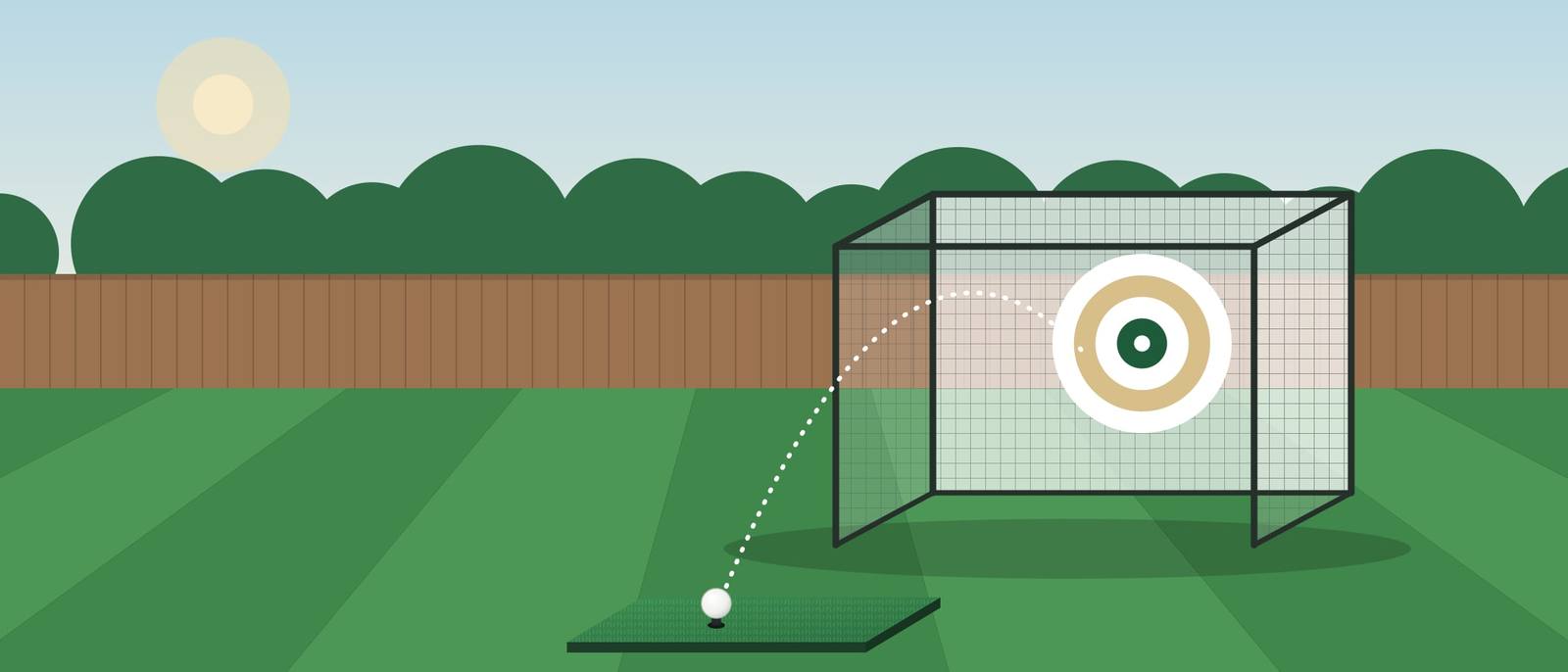
A golf net is the simplest way to hit full shots at home. It does not tell you where the ball would have finished, but it lets you work on strike, start line and routine whenever you have half an hour, without driving to a range. The right net is the one that fits your space and the shots you actually want to hit.
This guide covers the types of net, the sizes that matter, what to look for in the frame and netting, and how to set it up safely in a UK garden.
Types of golf net
| Type | Best for | Strong points | Watch out for |
|---|---|---|---|
| Pop-up net | chipping, wedges, short irons | quick to put up and pack away, light | small opening, moves in wind |
| Box net (frame net) | full shots with every club | wide opening, side panels, often a target | needs a flat area and some depth |
| Practice cage | regular full-swing practice | netting on all sides and overhead | big footprint, longer set-up |
| Chipping net | short game | small, cheap, easy to move | not made for full shots |
For most gardens, a box net with an opening of about 3 m is the all-rounder. A cage makes sense if you have the room and want a permanent practice bay, or if windows and neighbours are close. A pop-up net is handy as a second net for chipping, or where storage space is tight.
Size: the opening matters most
The opening is where the ball has to go. A wider opening gives you a bigger margin for error, which matters more with long clubs because a small error in the face angle sends the ball further off line before it reaches the net.
- Driver and woods: look for an opening of around 3 m wide and 2 to 2.5 m tall.
- Irons and wedges: an opening of about 2 m wide is usually enough.
- Depth: box nets need about 1 m behind the opening, cages need their full footprint.
Then work out the total footprint. Add the depth of the net, the distance between the ball and the net (follow the maker's instructions), and room behind the ball for your stance and backswing. If you plan to use a radar launch monitor, it also needs space behind the ball and a minimum distance of ball flight before the net. One popular portable radar unit, for example, asks for at least 2.4 m (8 ft) between ball and net.
Netting: what to look for
The mesh has to be smaller than a golf ball. Under the Rules of Golf a ball must be at least 42.67 mm (1.68 in) across, so any practice net worth having has holes far smaller than that. Most nets use knotless polyester or nylon netting.
Look for a separate impact area: a heavier panel, a double layer or a target sheet where most balls land. That is the part that wears first, and on a good net it can be replaced without buying a new net. Side panels on a box net catch strikes that hit the edge of the opening or miss it slightly.
A net needs some give. Netting that hangs with a little slack absorbs the ball and drops it to the ground. Netting stretched tight like a drum sends it back towards you. Many nets have a loose inner baffle or a sloping back panel for exactly this reason.
Frame: fibreglass or steel
Fibreglass poles are light, flexible and quick to put up, which suits a net that comes out at the weekend and goes back in the shed. They can split or splinter with age and long exposure to sunlight, so check them when you put the net up.
Steel frames are heavier and slower to assemble, but they stay put in wind and suit a net or cage that stays up for the season. Look for proper corner connectors and a way to peg or weigh down the base.
Rebound and safety
Even a good net returns some balls, especially low, hard shots into a taut section. A few simple habits keep everyone safe:
- Stand at the distance given in the instructions. Too close, and a rebound reaches you before you see it.
- Keep children, pets and anyone watching well away from the hitting area and never beside the net.
- Leave clear space behind the net so the netting can stretch without the ball hitting a wall, fence or car through it.
- Check the netting for holes and the frame for cracks before every session.
- Think about where a missed ball would go. A shank or a thin shot can miss the opening entirely, so choose a direction with a solid wall or open garden behind it, not a greenhouse or the neighbour's kitchen window.
Where to put it in a UK garden
Ground. A flat lawn or patio is ideal. On a lawn, put the hitting mat on a firm, level base, otherwise the mat rocks and wears the grass under it into a hollow.
Wind. British weather is the main enemy of garden nets. Peg the base, use guy ropes if the net has them, and take the net down when strong wind is forecast. A net that blows over can damage fences and cars and usually bends or snaps its poles.
Rain and winter. Netting and poles last longer when they are stored dry over the winter. If you want to keep practising through the darker months, a net in the garage is often the better plan. Our guide on how to practise golf at home in winter has ideas for both.
Planning. A free-standing net that you put up and take down is not a building. If you plan something permanent, such as a cage on a base or a structure with a roof, check with your local planning authority first, especially close to a boundary.
Mats and targets
You need something to hit from. A practice mat protects the lawn and gives you a consistent lie, and a tee for the driver. The mat in a starter set is fine for occasional practice; a thicker mat with a cushioned base is kinder to your joints if you hit a lot of balls. Our guide to choosing a golf hitting mat explains the differences.
A target turns hitting into practice. A ring target sheet in the back of the net gives you a start line to aim for, and two alignment sticks on the mat (one along your feet, one along the target line) help you check that you are aiming where you think you are.
Checklist before you buy
- Measure the space: width, depth and height where you will swing.
- Decide which clubs you want to hit, and choose the opening to match.
- Check the mesh and the impact area, and whether the impact panel can be replaced.
- Choose fibreglass for a portable net, steel for a net that stays up.
- Look for pegs, guy ropes and a carry bag.
- Plan the mat: size, base and tee height.
- Think about where a missed ball would land.
If you are still deciding between a net and a full simulator, the guide on home golf simulator space explains what a simulator bay needs. For nets, have a look at our golf nets, from a 3 m garden net with a target to a walk-in practice cage.
Frequently asked questions
What size golf net do I need for a driver?
Look for an opening of around 3 m wide and at least 2 m tall. That leaves a margin for a drive that starts off line. Smaller nets of about 2 m wide are fine for wedges and short irons, where the start line is more predictable.
Are pop-up golf nets any good?
They are good for what they are made for: quick set-up, chipping and shorter clubs, and packing away after each session. They are light, so they move in wind and can be less forgiving of a wild full swing than a framed box net or a cage.
Can I use a golf net in the garage?
Yes, if the garage is tall and wide enough to swing freely. Leave space behind the net so the ball does not push the netting into the back wall or a car, and protect anything breakable to the sides.
How long does a golf net last?
It depends on how often you hit into it, how hard and how long it stays outside. The impact area wears first. Check it before every session and replace the net or the impact panel as soon as you see fraying or holes.